If you’ve ever designed or maintained a network—whether for a modern office, a factory floor, or an outdoor installation—you’ve likely faced a critical choice: industrial PoE switch or standard PoE switch? Drawing on years of deployment and troubleshooting experience at Newbridge Communication Equipment Co., LTD, I’ve seen how the wrong choice leads to unstable connections, frequent downtime, and unnecessary costs. This article breaks down the core differences to help you make the right decision.
1. What Are They?
A PoE switch delivers both data and power over a single Ethernet cable to devices like IP cameras, Wi‑Fi APs, and VoIP phones.
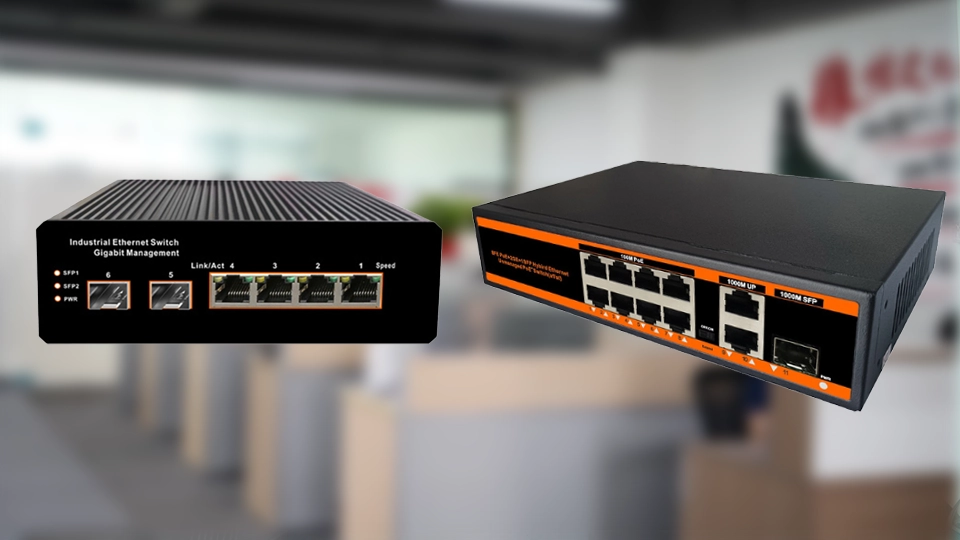
Standard PoE switch – Designed for controlled, mild environments (offices, conference rooms, retail). It prioritizes cost‑effectiveness and works well at 0 °C to 40 °C, clean air, and low electromagnetic interference (EMI).
Industrial PoE switch – Built for harsh conditions (factories, outdoor surveillance, traffic intersections, power substations). It uses heavy‑duty components and industrial‑grade reliability to withstand extreme temperatures, dust, moisture, vibration, and EMI.
2. Four Core Differences
Difference 1: Environmental Adaptability – The Toughness Gap
This is the most obvious difference. In one factory, standard switches kept failing because temperatures ranged from -10 °C to 50 °C, with metal dust and strong EMI.
Standard PoE switch – Temperature range 0 °C to 40 °C; IP20 rating (no dust/water protection); basic EMI compliance – vulnerable to motors, inverters, and high‑voltage equipment.
Industrial PoE switch – Wide temperature range -40 °C to +75 °C; IP30/IP40 or higher (dust‑resistant, splash‑proof); strict industrial EMC compliance (e.g. EN 55032 Class B) with 6KV+ surge protection.
Difference 2: PoE Compliance & Power Capacity – Safety & Compatibility
Not all PoE is the same. Using non‑standard switches with high‑power devices can burn out equipment.
Standard PoE switch – Mostly IEEE 802.3af (15.4W/port) or basic 802.3at (30W); limited total power budget (e.g., 120W for 8 ports); basic detection – risk of overload.
Industrial PoE switch – Full support for 802.3af/at/bt (PoE++), auto‑sensing; high total power budget (e.g., 240W for 8 ports), per‑port up to 60W (Type 3) or 90W (Type 4); short‑circuit, overload, and over‑voltage protection with automatic fault isolation.
Difference 3: Reliability & Redundancy – Uptime for Critical Networks
Downtime means lost productivity, security gaps, or safety risks. In a highway surveillance project, industrial switches with ring redundancy kept the network running through a fiber cut.
Standard PoE switch – Plastic casing, internal power supply, single‑plane circuit – vulnerable to vibration and impact; rarely supports redundant power or ring protocols; lifespan 3–5 years in ideal conditions.
Industrial PoE switch – Metal casing, reinforced components, vibration‑resistant mounts; dual redundant power inputs (AC/DC), ERPS/RSTP ring protocols (<10ms recovery), link aggregation – 99.999% uptime; lifespan 5–10 years with 72‑hour temperature aging testing.
Difference 4: Management & Scalability – Control for Complex Networks
For a smart factory with 20+ industrial switches, SNMP and web interfaces enabled remote troubleshooting, saving hours of on‑site work.
Standard PoE switch – Basic web UI or unmanaged; limited VLAN/QoS; no remote power control; fixed port counts (4/8/16); poor integration with industrial protocols (Modbus, PROFINET).
Industrial PoE switch – Advanced web, CLI, SNMP, and industrial protocol support; remote monitoring of port power, traffic, and fault status; one‑click port reset; modular port configurations (copper/fiber combo); VLAN, QoS, IGMP snooping for large‑scale networks.
3. How to Choose
Choose a standard PoE switch if:
Environment is indoor, temperature‑controlled (0–40 °C), and clean (offices, retail, classrooms)
You connect low‑power devices (basic IP cameras, VoIP phones, entry‑level APs)
Network is small (≤16 ports) with no critical uptime demands
Budget is tight and you only need basic PoE
Choose an industrial PoE switch if:
Environment is harsh (extreme temperatures, dust, moisture, vibration, EMI) – factories, outdoor, traffic, power grids
You connect high‑power devices (PTZ cameras, Wi‑Fi 6/7 APs, industrial sensors, video conference terminals)
Network is critical (surveillance, industrial automation, smart transportation) requiring 99.999% uptime
You need remote management, redundancy, or long‑term reliability
4. Final Thoughts
The difference comes down to purpose‑built design: standard switches optimize cost and convenience for mild environments; industrial switches prioritize toughness, safety, reliability, and control for harsh, critical scenarios. Cutting corners on switch quality in industrial or outdoor settings always costs more in the long run – downtime, replacements, and maintenance add up fast. The right choice ensures stable, efficient, and worry‑free network operation for years.
Summary Table: Industrial PoE Switch vs Standard PoE Switch
| Feature | Standard PoE Switch | Industrial PoE Switch |
|---|---|---|
| Environment | Indoor, controlled (0–40 °C), low dust/EMI | Extreme temps, dust, moisture, vibration, EMI (factories/outdoor/traffic) |
| Protection rating | IP20 (finger‑touch only) | IP30/IP40 or higher (dust‑resistant, splash‑proof) |
| Operating temperature | 0 °C to 40 °C | -40 °C to +75 °C |
| EMI & surge protection | Basic office‑level; vulnerable to motors/inverters | Industrial standards (e.g., EN 55032 Class B), 6KV+ surge protection |
| PoE standard | 802.3af (15.4W/port) or basic 802.3at (30W) | Full 802.3af/at/bt (PoE++), up to 90W/port |
| Power budget | Low (e.g., 120W for 8 ports) | High (e.g., 240W for 8 ports) |
| Safety protection | Basic detection; risk of overload | Short‑circuit/overload/over‑voltage protection; auto fault isolation |
| Chassis & build | Plastic, internal PSU, single‑plane PCB | Metal, reinforced components, vibration‑resistant |
| Redundancy | No redundant power or ring protocols | Dual redundant power inputs, ERPS/RSTP (<10ms recovery), link aggregation |
| Management | Unmanaged or basic web UI; limited VLAN/QoS | Web/CLI/SNMP, industrial protocols, remote power monitoring and control |
| Scalability | Fixed ports (4/8/16); no industrial protocol support | Modular copper/fiber ports; VLAN, QoS, IGMP snooping; Modbus/PROFINET ready |
| Lifespan | 3–5 years (ideal conditions) | 5–10 years (72‑hour temperature aging test) |
| Typical applications | Offices, retail, classrooms, small surveillance | Factory automation, outdoor security, intelligent transport, power substations |
| Budget focus | Cost‑effective | Reliability‑first |