In the early days of my career, I visited a steel plant in the height of summer. The ambient temperature on the factory floor hovered around 55°C, the air was thick with metallic dust, and every piece of equipment within fifty meters seemed to emit its own unique electromagnetic hum. The maintenance manager pointed to a rack of network switches—standard office-grade units they had tried using—and told me three had failed in less than two months.
“We thought a switch is a switch,” he said, shaking his head. He was not the first person to make that assumption, and he would not be the last.
That experience taught me something I have carried into every network deployment conversation since: the environment dictates the equipment, not the other way around. And when it comes to environments that fight back—factories, outdoor installations, transportation hubs, mining sites, oil and gas facilities—you need a fundamentally different category of switch. You need an industrial PoE switch.
What Exactly Is an Industrial PoE Switch?
Let us strip away the jargon and start with the basics.
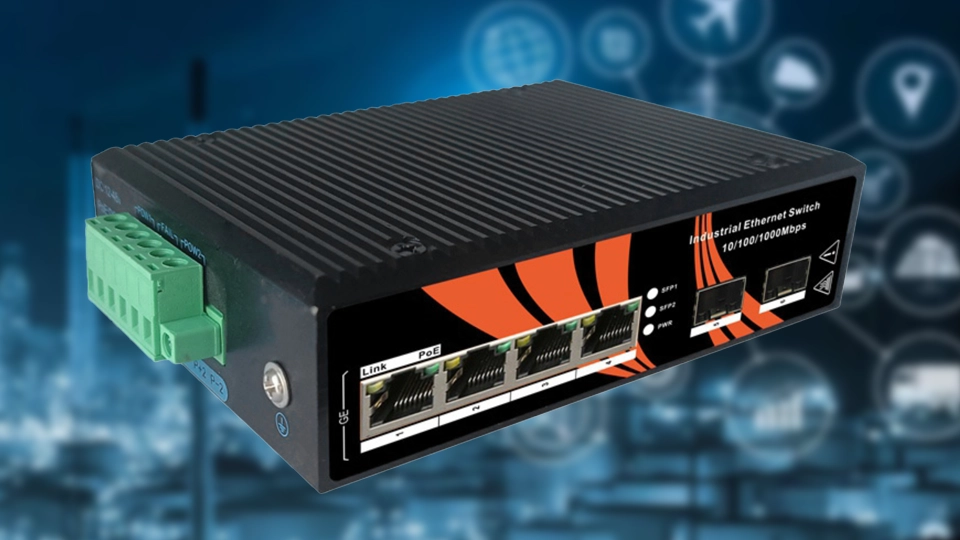
An industrial PoE switch is a ruggedized network switch designed specifically for harsh, demanding environments. It combines two essential functions: standard Ethernet data switching and Power over Ethernet (PoE) delivery—all through a single Ethernet cable to each connected device. So instead of running separate power lines to every IP camera, wireless access point, sensor, or VoIP phone, one cable handles both data and electricity simultaneously.
But the real distinction lies in the construction. Industrial PoE switches—sometimes called “hardened” or “rugged” PoE switches—are purpose-built for conditions where commercial switches simply cannot survive-15. That means:
Wide temperature tolerance, typically from -40°C to 75°C, compared to the 0°C to 45°C range of a standard office switch
Rugged metal enclosures with IP30 or higher ingress protection, designed to resist dust, moisture, and corrosive elements
Fanless thermal design that eliminates moving parts and the associated failure risks in dusty or high-vibration settings
Redundant DC power inputs (typically 48V-57V DC) that ensure uninterrupted operation even if one power source fails—something commercial AC-powered switches simply cannot offer
Superior electromagnetic interference (EMI) resistance, with surge protection up to 6kV and electrostatic discharge immunity up to 15kV in well-engineered models
On the PoE side, industrial-grade switches support the full IEEE standards spectrum:
| Standard | Power Per Port | Typical Devices |
|---|---|---|
| 802.3af (PoE) | Up to 15.4W | Fixed IP cameras, basic sensors, entry-level access points |
| 802.3at (PoE+) | Up to 30W | PTZ cameras, industrial sensors, VoIP phones |
| 802.3bt (PoE++) | Up to 60W or 100W | High-end PTZ cameras with heaters, LED lighting, robotic vision systems, industrial terminals |
A quality industrial PoE switch can deliver 60W or even 90W per port under the 802.3bt standard, which is essential when you are powering AI-enabled cameras, outdoor wireless APs with heaters, or edge computing nodes.
Beyond raw power, many industrial PoE switches incorporate intelligent management features—VLAN segmentation, QoS traffic prioritization, SNMP monitoring, and rapid ring network redundancy—that transform them from simple connectivity devices into full-fledged network control points.
The Industrial vs. Commercial Reality Check
I sometimes hear people say, “Why should I pay more for an industrial switch when a commercial one has the same port count?” The answer lies in what you cannot see on a spec sheet until things go wrong.
Commercial PoE switches are designed for air-conditioned server rooms, tidy office ceilings, and climate-controlled environments. Their operating temperature window is narrow—typically 0°C to 45°C-16. They use AC power with single-supply designs. Their cooling relies on internal fans. Their enclosures are built for rack mounting, not for exposure to vibration, dust, or corrosive atmospheres.
Industrial PoE switches, by contrast, are engineered from the ground up for the opposite of that. Here is a side-by-side reality check:
| Factor | Commercial PoE Switch | Industrial PoE Switch |
|---|---|---|
| Temperature range | 0°C to 45°C | -40°C to 75°C |
| Power input | AC 100-240V, single supply | DC 48-57V, dual redundant inputs |
| Cooling | Fan-based | Fanless, passive heat dissipation |
| Mounting | 19-inch rack | DIN-rail or wall-mount |
| Enclosure | Standard enterprise chassis | Rugged metal, IP30+ rated |
| EMI protection | Minimal | 6kV surge, 15kV ESD in robust designs |
| Redundancy protocols | Basic STP/RSTP | ERPS with sub-50ms failover, dual power |
| Service life (typical) | 3-5 years in benign conditions | 5-10 years in harsh conditions |
That last row matters more than many people realize. A commercial switch deployed in a hot, dusty outdoor cabinet might fail within months. An industrial switch in the same environment is designed to function reliably for five to ten years. The upfront cost difference, when amortized over that service life, often tilts heavily in favor of the industrial option—especially when you factor in the cost of unscheduled downtime and emergency maintenance visits.
When You Absolutely Need an Industrial PoE Switch
Not every deployment calls for industrial-grade hardware. If you are wiring up an air-conditioned office with a handful of VoIP phones and Wi-Fi access points, a quality commercial PoE switch will serve you just fine. But there are specific scenarios where choosing anything less than industrial-grade is a calculated risk I would not advise taking.
Outdoor Surveillance and Security Systems
This is arguably the most common reason people search for industrial PoE switches, and with good reason. Outdoor IP cameras—especially PTZ (pan-tilt-zoom) models with built-in heaters, IR illuminators, and wipers—demand reliable power under conditions that swing wildly. I have seen installations where a standard switch in a roadside cabinet failed after the first summer heatwave, taking an entire perimeter surveillance system offline.
For 4K or 8MP PTZ cameras mounted on poles, rooftops, and campus perimeters, you need a PoE switch that can deliver stable PoE++ power—often 60W or more per port—along with robust fiber uplinks for long-distance connectivity back to the NVR-20. A managed industrial PoE switch also lets you remotely power-cycle an unresponsive camera, which beats rolling a truck to a remote site at 2 a.m.
Factory Floors and Manufacturing Environments
I will never forget the steel plant I mentioned earlier. Factories present a perfect storm of challenges: extreme ambient temperatures, pervasive dust and oil mist, heavy machinery generating constant vibration, and motors and drives spewing electromagnetic interference across the entire spectrum. This is why manufacturing environments are one of the primary use cases for industrial PoE switches.
In automated production lines, these switches connect vision inspection cameras, robotic controllers, industrial sensors, and edge computing devices—all while withstanding conditions that would destroy commercial networking gear in weeks-48. The ability to mount on a DIN rail inside a control cabinet further simplifies integration into existing industrial electrical infrastructure.
Intelligent Transportation and Traffic Systems
Roadside cabinets along highways experience temperature swings from freezing winter nights to blistering summer afternoons—all while housing electronics that must work 24/7, 365 days a year. Traffic monitoring cameras, license plate recognition systems, variable message signs, and emergency communication points all depend on PoE switches that will not flinch at -30°C or +65°C.
A switch failure here is not just an inconvenience—it can create genuine public safety risks.
Energy, Mining, and Remote Infrastructure
Wind farms, solar installations, oil and gas facilities, and mining operations share a common thread: they are often located far from climate-controlled buildings, with unreliable grid power and extreme environmental stress. Redundant DC power inputs become non-negotiable here, as does the ability to operate without active cooling.
Smart Buildings and Edge Computing Nodes
Even within “indoor” environments, there are spaces that behave like outdoor ones—boiler rooms, underground parking garages, elevator shafts, ventilation ducts, and telecommunications risers. These areas experience high temperatures, humidity, and electromagnetic noise from nearby power equipment. Industrial PoE switches with wide temperature tolerance and EMI shielding are the right choice for these edge computing nodes, AI analytics devices, and IoT gateways.
If the switch is going to live in a controlled environment—an air-conditioned server room, a tidy office ceiling, a climate-maintained wiring closet—a commercial PoE switch is perfectly adequate. But if you answer “yes” to any of the following, you need to be looking at industrial-grade hardware:
Will the switch be exposed to temperatures outside the 0°C-45°C range?
Is dust, moisture, oil mist, or corrosive gas present at the installation site?
Would a network outage at this location create a safety hazard or significant financial loss?
Does the switch need to power high-wattage devices like PTZ cameras, outdoor APs with heaters, or industrial terminals?
Is AC power unreliable or unavailable at the installation point?
How to Choose the Right Industrial PoE Switch
When I work with teams selecting industrial PoE switches, I guide them through five decision points. Skipping any of these almost always leads to regret down the line.
Step 1: Determine Your PoE Power Budget
This is the single most overlooked step, and it is where I see the most mistakes. The “power budget” of a PoE switch is the total wattage it can deliver across all ports simultaneously—and it is not the same as the sum of per-port maximums.
Here is a practical example: Suppose you are deploying eight outdoor PTZ cameras, each drawing 22 watts at peak (with heater and IR active). That totals 176 watts. But you need headroom—a 20% margin is widely recommended as good practice. So your minimum power budget becomes 176W × 1.2 ≈ 211W. If the switch you are eyeing is rated at 185W total PoE budget, it will fail under peak load even though each individual port might support 30W.
Also, check the PoE standard required by your devices. A standard fixed camera might work fine with 802.3af (15.4W), while a PTZ model with a heater may require 802.3at (30W) or even 802.3bt (60W+).
Quick power calculation worksheet:
List all PoE-powered devices and their maximum wattage
Sum the totals
Add 20% margin
Ensure the switch’s rated total PoE budget exceeds this number
Verify that each device’s wattage falls within its assigned port’s per-port capability
Step 2: Match the Environmental Specifications
Look at temperature range first. An industrial switch rated for -40°C to 75°C will handle virtually any deployment scenario you can throw at it. If your environment is less extreme—say, a non-air-conditioned indoor cabinet that peaks at 50°C—you might have some flexibility, but never cut corners here. The temperature specification is the single best indicator of overall build quality in this product category.
Check ingress protection (IP rating) next. IP30 is the baseline for industrial switches installed inside control cabinets. If the switch will be mounted externally or in a location exposed to water spray, you may need IP65 or higher, though in most industrial scenarios, the switch is housed inside a sealed cabinet that provides the primary environmental barrier.
Step 3: Choose Managed vs. Unmanaged
Unmanaged industrial PoE switches are plug-and-play: no configuration, no monitoring, no remote management. They are suitable for simple, isolated deployments where you trust that everything will just work. I use them sparingly—typically for small, non-critical installations.
For anything that matters—surveillance systems, production lines, remote infrastructure—I strongly advocate for managed switches. The ability to remotely monitor port status, configure VLANs, prioritize critical traffic with QoS, and power-cycle individual PoE ports can save hours of troubleshooting and unnecessary site visits. Managed switches also support redundancy protocols like ERPS (Ethernet Ring Protection Switching), which provides network failover in under 50 milliseconds—something no unmanaged switch can do.
Step 4: Verify Redundancy Features
Industrial environments do not forgive single points of failure. Look for:
Dual redundant power inputs: If one power supply fails, the switch continues operating on the second. This is standard on quality industrial switches and should be considered a minimum requirement for critical deployments.
Ring network redundancy: Protocols such as ERPS enable the network to self-heal in under 50ms if a link goes down, preventing cascading failures.
PoE watchdog / auto-recovery: The switch periodically checks if connected PoE devices are responsive and automatically power-cycles them if they have hung—a surprisingly valuable feature when you are managing dozens of remote cameras or sensors.
Step 5: Consider Port Types and Uplink Needs
Copper RJ45 ports handle the edge devices. But what about the uplink—the connection back to your core network or NVR? If your switch is located more than 100 meters from the network backbone, you need fiber uplink ports (typically SFP slots). Fiber also provides electrical isolation, which can be important in environments with high ground potential differences, such as between buildings or across large outdoor sites.
A Word on Longevity
There is something I have learned from watching networks evolve over more than a decade: the cheapest component in a deployment is rarely the one that costs the least upfront. It is the one you never have to think about again after you install it.
Industrial PoE switches are designed with that philosophy baked into their engineering. The corrosion-resistant metal housings, the fanless thermal designs, the redundant power paths, the conservative component ratings—all of these contribute to the 5-to-10-year service life that defines this category. When you compare that against the cost of replacing a failed commercial switch—not just the hardware, but the truck roll, the overtime labor, the downtime, the lost data—the economics become clear.
At Newbridge Communication Equipment Co., Ltd., a manufacturer established in 2004 in Shenzhen, China, I have seen this principle applied consistently across their entire networking product range—from industrial PoE switches to fiber optic switches and managed network equipment. In environments where reliability means everything, investing in properly engineered, purpose-built hardware is not an extravagance. It is simply the logical choice.